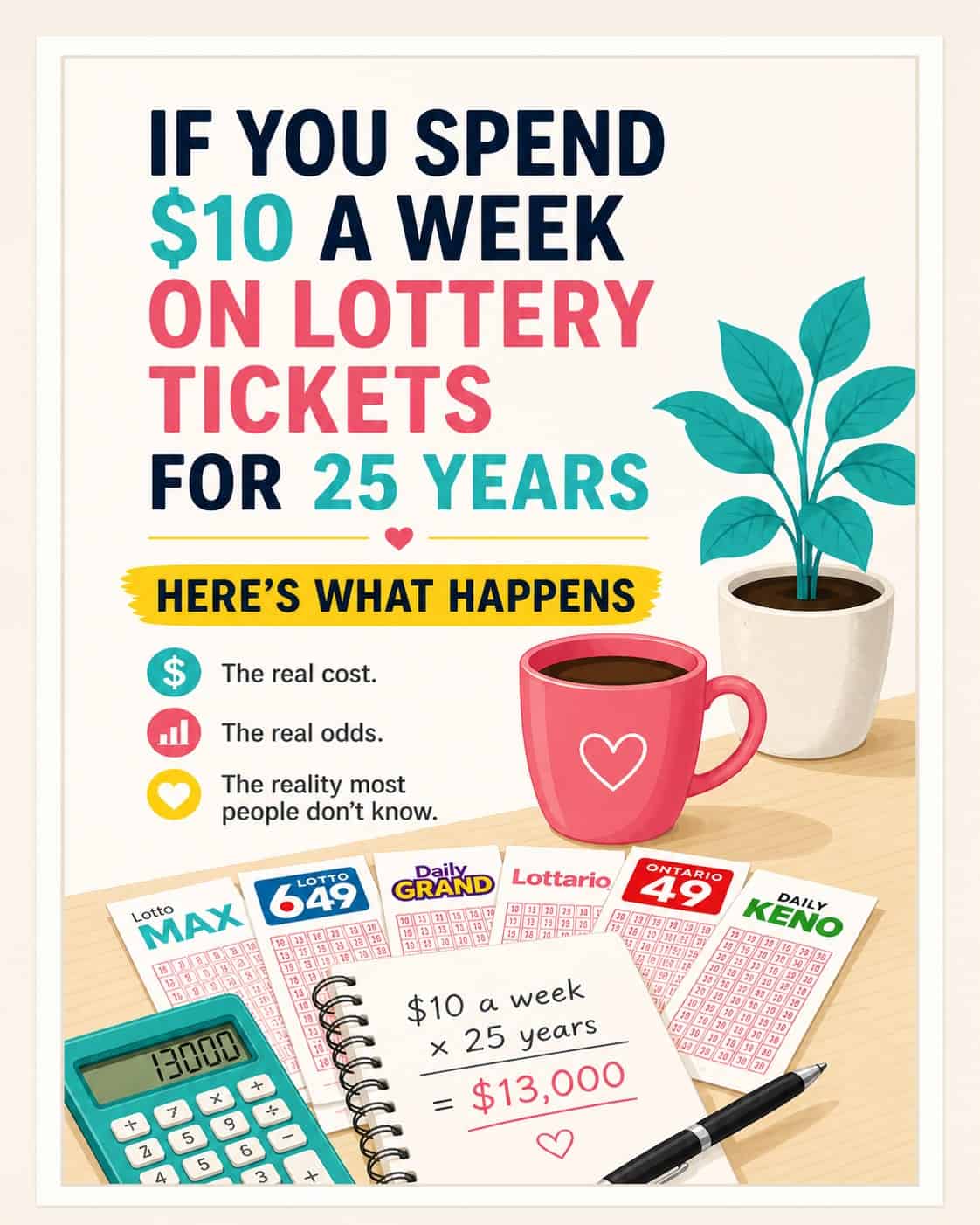
Ten dollars does not feel like much.
It is a quick decision at the counter. A small moment of possibility. A habit that is easy to justify.
But what happens if that habit continues for years
Let’s walk through the numbers clearly and honestly.
The real cost over time
Spending 10 dollars per week adds up faster than most people expect.
- 52 weeks per year
- 25 years
- 1,300 tickets purchased
That equals:
$13,000 spent
That number alone surprises most people.
Before even looking at odds, it is worth pausing here. This is not an occasional expense. It is a long-term financial pattern.
The most common lottery games in Ontario
In Ontario, the most widely played lottery games include:
- Lotto Max
- Lotto 6/49
- Daily Grand
- Lottario
- Ontario 49
- Daily Keno
Each game offers smaller prizes along the way, but most players are focused on the top prize. That is where the odds matter most.
The odds of winning the jackpot
Here are the approximate odds of winning the top prize in each game:
- Lotto Max: about 1 in 33,294,800
- Lotto 6/49: about 1 in 13,983,816
- Daily Grand: about 1 in 13,348,188
- Ontario 49: about 1 in 13,983,816
- Lottario: about 1 in 4,072,530
Daily Keno varies depending on how numbers are selected, but top prize odds are typically extremely low.
What happens after 25 years of playing
If someone buys one ticket per week for 25 years, they will purchase about 1,300 tickets.
That does increase the overall chance of winning at least once. But not by as much as most people expect.
Here is what that looks like in practical terms.
Lotto Max
Even after 25 years, the cumulative chance of winning the jackpot is about 0.0039 percent.
That is roughly equivalent to about 1 in 25,000.
Lotto 6/49 and Ontario 49
After 25 years, the cumulative chance is about 0.009 percent.
That is roughly about 1 in 11,000.
Daily Grand
After 25 years, the cumulative chance is about 0.01 percent.
That is about 1 in 10,000.
Lottario
This game has better odds, but the cumulative chance is still only about 0.03 percent.
That is about 1 in 3,100.
Why the odds barely change over time
This is where most people misunderstand how lottery games work.
Each ticket is an independent event.
Buying a ticket this week does not improve your chances next week. Over time, buying more tickets increases your total chance slightly, but the odds remain extremely low.
Even after 25 years of consistent play, the probability of a jackpot win is still well below 1 percent.
What people actually win
Most lottery wins are not jackpots.
They are:
- small cash prizes
- free plays
- partial matches
These smaller wins create the feeling of progress, but they rarely offset the total amount spent over time.
For most people, total winnings are significantly less than total spending.
A clearer way to think about it
Lottery tickets are not an investment strategy.
They are a form of entertainment.
That distinction matters.
If someone chooses to play, it should be with a clear understanding:
- the cost adds up over time
- the odds remain extremely low
- the outcome is almost always a net loss
How this was calculated (Boring math alert!)
To estimate the long-term probabilities, we used a standard probability model.
Each draw is independent, meaning each ticket has the same odds every time.
We calculated:
- Total tickets purchased over 25 years: 1,300
- Official jackpot odds for each game
- The probability of at least one win over time
This can be estimated using:
Probability of at least one win =
1 minus (1 minus odds per ticket) raised to the number of tickets
Because the odds are so small, this is very close to:
Total tickets divided by the odds of the game
These figures are estimates, but they are accurate enough to show the real pattern.
Final thought
Spending 10 dollars a week on lottery tickets for 25 years results in a 13,000 dollar spend with a very small chance of a life-changing return.
For most people, the value is not in winning.
It is in the moment of possibility.
Understanding that difference is what turns a habit into a conscious choice.